100. MDK (Shiny Entertainment, 1997)
A downright manic action-shooter-platformer hybrid that could only have come to us from the company that created Earthworm Jim. The Giger-esque visuals and story about enormous alien mobile cities strip-mining the planet make it sound pretty grim and nightmarish on paper, but the quirky humor throughout adds plenty of levity, with shooting galleries of aliens that childishly taunt the player, clever moments like having to disguise yourself as a robot to sneak through a heavily guarded corridor, and hilarious powerups and weapons like "the World's Most Interesting Bomb" and "the Very Large Hamster Hammer".
99. Simcity (Maxis, 1989)

The story of Simcity is a famous one - Will Wright developed the top-down shooter "Raid on Bungeling Bay" for the Commodore 64, but had more fun designing maps and upgrading the editor than playing the game itself. Said maps were surprisingly intricate and realistically designed - there are plane runways and seaports, networks of roads and buildings, rivers and inlets, radar dishes tracking your movement and even boats ferrying supplies between the islands, so it made the game world feel more dynamic and alive than most top-down shooters. Eventually he expanded that idea into a full-fledged city planning and building simulation, and the end result was SimCity. It doesn't sound like a particularly fun game on paper - constructing your metropolis while managing crime, pollution, traffic, sim health, entertainment and land value - but its addictive design and random disastrous events like fires, floods, tornadoes and monster attacks kept it fresh and engaging. It has also since been made open-source (albeit under the name "Micropolis" due to copyright concerns) and ported to just about every platform imaginable, so you have no excuse not to check it out in some form
!
98. Diablo (Blizzard Entertainment, 1997)
Warcraft and Lost Vikings were fairly popular games in their time, but Diablo is the game that really put Blizzard on the map. Taking the concept of games like Rogue, adding an action bent and dousing the whole thing in a heavy grim atmosphere, it definitely awed people at a glance. It only became more immersive thanks to its fantastic soundtrack and a surprisingly good story with some high quality voice over, and the fact that you got a random shuffle of quests, items and spells each time you played lent it quite a bit of replay value. It had an official (though non-canon) expansion in Hellfire as well, adding in several new quests and three new playable classes (though you do have to do some file-editing to make them all accessible). While largely overshadowed by its sequel these days, Diablo is a historic game that is not to be missed.
97. Are You Afraid of the Dark? The Tale of Orpheo's Curse (Viacom New Media, 1994)
A tie-in to the Nickelodeon horror anthology show, which plays out much like an episode of it, even featuring the Midnight Society for the framing device around the story (with the player telling the Tale of Orpheo's Curse in hopes of becoming a member). The game itself is also a surprisingly good point-and-click adventure, with environments rendered from still photos and CGI, a lot of bizarre sights to see and some eerie music making for a creepy and tense experience. Even the acting in-game is surprisingly good and the puzzles actually make sense, so it's a good experience despite being a horror themed title for kids. Sadly it hasn't resurfaced on any digital platforms owing to licensing issues, but if you can find a copy it's a pretty fun adventure.
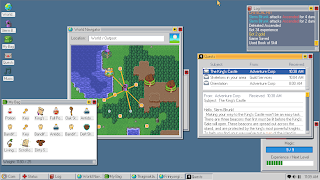
96. Kingsway (Andrew Morrish, 2017)

Roguelikes are definitely a hallmark of PC gaming, bringing a unique brand of challenge and staggering replayability that few other genres can even hope to match. I'm not the biggest fan, that said - they generally have to have a pretty unique hook to hold my attention for very long, otherwise it's just monster bashing with cheap deaths mixed in. Kingsway is one that certainly has a unique presentation, putting you at the helm of a Windows-95-esque operating system to travel about the world, manage your inventory and stats, accept quests (via a messaging app) and even play background music on a Winamp look-alike. Combat similarly has enemies pop up in windows that constantly move about the screen, with you having to hit buttons to attack, defend and use abilities, as well as evade their attacks (in the form of a popup that flies across the screen or arcs, simulating things like firing arrows or thrown bombs). A clever idea that's executed well, and the end result is some good tongue-in-cheek entertainment.
95. Get Medieval (Monolith Productions, 1998)
A top-down action game that takes the arcade classic Gauntlet, combines it with elements of Gauntlet and tops it off with a little bit of Gauntlet for good measure. ...Yeah this one certainly makes no secret of its inspirations, even suspiciously being released only a couple of months before Atari rebooted the series with Gauntlet Legends. But you know what? That's no bad thing in my book. It's just pure hack-and-slash fun, mowing your way through hordes of enemies, finding keys to open doors, and using magic in a pinch to get waves of enemies off your back. It does add a few new elements to the formula though, letting you upgrade your stats with powerups and adding in elements like traps that do things like reverse your controls or thieves that try to steal your powerups and vamoose. It's not the most original game ever, but it's great fun and supports four players both over a network and in local play.
94. Horizon's Gate (Rad Codex, 2020)
A
game that has been described by many as "Final Fantasy Tactics by way
of Uncharted Waters", and upon playing it, I can confirm that is indeed
the case. You build a character, take part in turn-based battles both
on foot and by sea, unlock new classes as the game progresses, and can
basically explore, trade or become a privateer at your leisure, taking
part in ship battles or legitimate business to earn loot for later
upgrades. Inventory management and item manipulation is simple as can
be too, using a keyboard-and-mouse interface that reminds me a bit of
the classic Ultimas. It's certainly not the deepest example of anything
it attempts to be, but it is a lot of fun, and really, that's what I
come to a game for anyway. Sacrilege, I know.
93. Worms: Armageddon (Team-17, 1999)
Just one game in the long-running Worms turn-based warfare strategy series, and the one widely regarded as the best in the franchise. Unlike many of its sequels, it gives players the option to have teams larger than four worms (six or eight, depending on the number of players in the game), allows for custom team voices and terrain to be imported and has just the right blend of weapons, gadgets and options to make for lengthy, yet engaging online battles - from airstrikes to poisonous skunks to flamethrowers to Street Fighter style martial arts, you won't be wanting for ways to lay down the pain. Not to mention that it's always more fun dropping a concrete donkey on a bigger group than a smaller one, of course. A standout in the turn-based artillery combat genre.
92. Out of This World (Delphine Software, 1991)
Also known as "Another World", this was a game created from the get-go to be a Dragon's Lair-esque cinematic action adventure on a much lower budget. Utilizing vector graphics instead of drawn cels, the game's visual design had relatively little detail but very smooth animation, giving it a nicely cinematic flair regardless. The end result was certainly distinctive and memorable, adding a grim yet beautiful aesthetic to the game and its many, many death scenes. The gameplay was also quite solid, if heavily trial-and-error based as you tried to solve puzzles, evade enemies and figure out the correct sequence of events in order to survive another melee with aliens and see your way to the end of this strange tale.
91. Lemmings (DMA Design, 1991)
A popular puzzle game that spawned a horde of rereleases, updates, sequels, expansions, clones and parodies, Lemmings is a simple concept - get a quota of the little rodents safely to the goal. To this end, one picks a few out of the crowd and assigns them jobs meant to help the others avoid danger or bypass obstacles - whether simply stopping and forcing them to go the other way, digging through dirt, climbing up walls, parachuting down long drops, or blowing themselves up to clear an obstacle from the others' path. Once enough are safely through the exit door, the next stage begins. Simple enough in concept, but many of the later stages get deviously difficult, requiring some very fast thinking to succeed. Given just how prolific and popular the series was, if you owned basically any game platform out in the early '90s, you probably played or at least saw Lemmings or one of its sequels/spinoffs/expansions at some point.