Check out my other site, RPGreats, for honest RPG reviews!

Top 111 PC Games, #70-61

70. Fallout: A Post Nuclear Role Playing Game (Interplay, 1997)


Drawing heavy inspiration from their earlier hit "Wasteland" (with the license having fallen to EA years prior), Fallout's creators set out to create a bleak post-apocalyptic landscape for the player to explore, and did so admirably, combining a grim atmosphere with a sly sense of humor throughout.  What really sold the game, though, was the sheer amount of thought put into its story and design - rather than encourage the player to just mindlessly blast everything as so many RPGs of the time were wont to do, the player is given many choices to deal with every questline put before them - a combative approach, stealthy approach and even pure diplomacy will work in almost any situation.  Hell, it's even possible to complete the game without firing a single shot or witnessing a single death.  The first in a great series of games.

69. Simcity 3000 Unlimited (Maxis, 1999/2000)
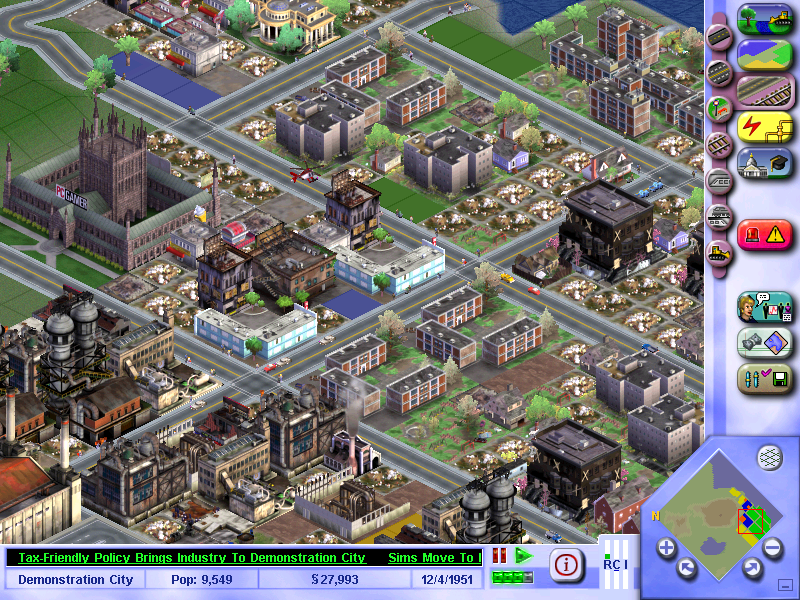
Simcity was of course a big hit and Simcity 2000 even moreso, so 3000 had quite big shoes to fill to live up to its legacy; moreso because it was the first game in the series that Will Wright wasn't involved in creating.  They did an admirable job, though - initially planned to be in full 3D, those plans were eventually scrapped owing to hardware limitations of the time and the game went back to a 2D style, giving it a substantial visual overhaul and larger maps to compensate.  One prominent new element is that you now have to implement trash collection services, and you have the option to make business deals with neighboring cities - either to offload some of your own problems at a cost or take on some of theirs for extra revenue.  You'll also get proposals for things like golf courses, maximum security prisons or casinos, which bring in a substantial amount of cash but often come with a sizable hit to land value, crime or pollution.  The Unlimited expansion (released under many different names depending on the region) also adds in numerous real-life landmarks to decorate your cities with and even an easy-to-use editor to create your own, letting you put some amazing new touches on your creations.  It wasn't a huge leap over 2000 in terms of design and a lot of the new features feel superfluous at best and irritating at worst though, so it's not one I revisit nearly as much as 2000 or 4.

68. The Secret of Monkey Island (LucasArts, 1990)

The first entry in what would become a long-running (if not exactly strong-selling) series, Secret of Monkey Island is a humorous point-and-click adventure starring the bumbling Guybrush Threepwood, who is tasked with completing three trials to become a pirate.  These take the form of some brilliantly funny puzzles - the insult-swordfighting is a particular favorite - and eventually culminate in a showdown with the vicious ghost pirate LeChuck, who would become Guybrush's recurring nemesis throughout the series.  The second half of the game does feel a bit rushed, but overall this is still a worthy adventure game and a solid start to a consistently fun and irreverent franchise.

67. Heretic II (Raven Software, 1998)

Most people know about Heretic, but not too many people know it had a sequel.  Mostly because it didn't sell particularly well and owing to a dispute over rights to the game, it has not resurfaced on any digital distribution stores.  Which is a shame, as it's quite a unique and fun experience in its own right.  A third person action game that takes a few cues from Tomb Raider, with some polished platforming mechanics and a bit of focus on puzzle solving.  It doesn't lose sight of what made the original popular, though - after all, it's built in the Quake II engine, which lends itself perfectly to fast-paced projectile-slinging action against hordes of monsters.  Even melee brings some clever mechanics, with sweeping blows that deal heavy damage (and gory finishers) to enemies and even letting you use your staff to pole-vault, which both serves as a longer jump and a powerful mobile attack.  Heretic II is far less famous than its predecessor, but no less fun.

66. Heretic (Raven Software, 1994)

As popular as Doom was, it was little surprise that it would get a number of spinoff games and engine licenses.  Heretic is definitely one of the more memorable ones, taking the basic monster-blasting, puzzle-solving format of Doom and putting a coat of dark fantasy on everything.  Golems, axe-throwing skeleton knights, sorcerers and demons, among many others, stand in your way, while you get several weapons like a magic staff, a triple-firing crossbow, a fireball-launching mace and my personal favorite, gauntlets that launch lightning at your enemies.  More than that, though one could actually pick up many powerups and use them when needed, rather than being forced to activate and use them right then and there.  From temporary flight to powering up all of one's weapons to simply restoring a bit of health on-demand, they were all quite handy to have.

65. Cave Story (Dōkutsu Monogatari) (Pixel, 2004)


With the internet's explosion in popularity came an interest in indie games old and new, with sites like Newgrounds giving a lot of developers and fans a place to show off their talents and numerous abandonware sites archiving obscure and forgotten classics.  Cave Story is one that came to peoples' attention not long after its initial release in 2004, garnering a lot of attention for its high quality Metroid-like design, presentation reminiscent of 8 and 16-bit retro titles, having a surprisingly engrossing story and being created over the course of five years by a single developer.  Since then it's gotten tons of attention in the form of fan translations, ports to numerous platforms (official and otherwise), a slew of remakes, mods and source ports, and even a fan-created level editor.  

64. Ys Origin (Nihon Falcom, 2012)


A prequel to the long-running Ys action-RPG series and the first to not star Adol Christin (although he is playable in some of the bonus modes), Ys Origin can also be considered more of a straight dungeon crawler - the game takes place entirely within the Devil's Tower, and the player is given a choice of three protagonists to control - Yunica plays most similarly to Adol, relying mostly on melee attacks, Hugo Fact relies on ranged magic and "Claw" (unlockable after completing the game once) is a high-risk high-reward character, with short ranged but rapid strikes.  The overall story changes slightly depending on your character, you earn and purchase upgrades as the story progresses to power up, and extra modes like a boss rush and time attack add plenty of replayability.

63. Abuse (Crack dot Com, 1996)

A run-and-gun shooter that plays like one part Contra, one part Doom and one part Smash TV, Abuse was like nothing else on PC at the time.  Basically a 2D platformer with 360-degree movement and aiming via the mouse, the game took advantage by having enemies be fast and ruthless and come at you from every angle, quickly overwhelming you if you weren't careful.  Of course, it also took cues from games like Doom with multiple hidden secrets and powerups to find in each stage and even a few alternate pathways to discover. Its source code has also been released, allowing it to get ports to multiple platforms, so there's no excuse to not check out Abuse. 

62. The Dig (LucasArts, 1995)

Another adventure title from the legendary LucasArts, though unlike most, The Dig doesn't have a lot in the way of the company's quirky humor, opting to tell a more somber, serious and high-concept science fiction story.  Starring a team of scientists unexpectedly whisked away to an alien world devoid of intelligent life but full of advanced technology, they set out to uncover exactly what led it to its current state and discover a way home.  The Dig was also a very high-end production for its time, having surprisingly well-known actors voicing the main characters and some incredible atmospheric music by Michael Land.

61. The Curse of Monkey Island (LucasArts, 1997)

The Monkey Island series is a beloved classic among adventure game fans; following the exploits of the bumbling wannabe-pirate Guybrush Threepwood, he seeks to win the affections of Elaine Marley and frequently clashes with his nemesis, the evil undead pirate LeChuck.  Curse took the series in a bold new direction with a fresh visual style, plenty of animated cutscenes and perfectly cast voiceover complementing the humor throughout.  The scenarios are as absurd as ever - this time with Guybrush trying to reverse a voodoo curse he's unintentionally afflicted Elaine with - and that of course lends itself to plenty of laughs.  The interface was newly reworked too, using a simpler "verb coin" with three general commands instead of the array of commands from earlier SCUMM games.  The puzzles definitely didn't suffer for it, though - you're still in for a challenge, especially in "Mega Monkey" mode.